Software-defined machines are redefining the off-highway industry. What once was primarily driven by mechanical engineering and later electronics is now evolving into a new generation of machines where software, data, and connectivity increasingly determine performance, upgradability, and differentiation.
At the same time, this shift is not only about technology. It reflects a broader transformation in how humans design, operate, and interact with machines. The human factor is coming into focus, shaping both the opportunities and the responsibilities that arise with this technological evolution.
For 25 years, TTCONTROL has contributed to this development by combining hardware and software into integrated systems for demanding off-highway applications. Today, the company is extending this expertise toward software-defined architectures and AI-driven solutions.
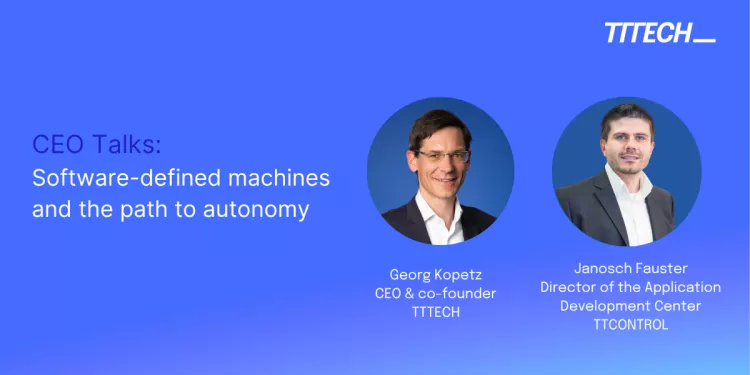
In this edition of CEO Talks, Georg Kopetz, CEO and co-founder of TTTECH, and Janosch Fauster, Director of the Application Development Center at TTCONTROL, share their perspectives on this transformation and discuss what it means for the future of machines and the people working with them.
From automation to autonomy – understanding software-defined machines
Software-defined machines are becoming an increasingly prominent topic across the industry. Before we explore specific use cases, how would you explain what a software-defined machine is, and why it is becoming so relevant?
Georg Kopetz: What we currently observe are two very important trends. On the one hand, the transition from automation to autonomy, and on the other hand, a significant increase in software and AI in machines. Even though more and more software is generated or supported by AI, system architecture remains the key element. This is exactly where software-defined machines become relevant.
When we talk about software-defined machines, we are also referring to enabling new business models and architectures. They allow us to perform software upgrades much more easily and activate features over time. This is closely linked to connectivity, especially the connection between the cloud and the edge. This means machines are no longer static products, instead, there is a continuous flow of data, allowing new functionalities to be deployed throughout the machine’s lifecycle.
Janosch Fauster: From an industry perspective, this development is a natural evolution. We started with mechanical machinery, then moved to electronic systems - where TTCONTROL has been active for 25 years - and now we are moving toward highly integrated systems with a strong software focus.
If you design machines in a smart way, you can unlock many features simply through software. This enables a shift from systems where the operator performs all tasks to systems that provide comfort and safety functions, and further to highly automated workflows. In these workflows, entire processes can be automated, reducing the need for highly specialized operator skills. And if we take it one step further, we move toward fully autonomous systems where no operator is required anymore. In such systems, a large share - around 80% - of functionality is software-driven.
Subscribe to our newsletterand receive CEO updates directly to your inbox
From cameras to AI sensors – unlocking existing potential
Before looking at specific applications, let’s take a closer look at existing sensor systems, particularly cameras. How do you see their role changing in modern machine architecture?
Georg Kopetz: Today, machines already come equipped with a large number of sensors. The key idea is that these sensors can be reused and extended through software-defined functionality. This not only enables new features but also supports continuous flow data across the entire lifecycle, ultimately changing how machine makers interact with their customers and how operators anticipate and experience ongoing improvements.
The camera is a very interesting example in this context. As we often say, it is the ultimate sensor because it captures a rich set of environmental information. But this is only true if the camera is combined with sufficient processing capabilities, machine learning, and AI at the edge, as well as with cloud infrastructure. Without this, the camera remains a visualization tool - with it, it becomes a perception system.
Janosch Fauster: A typical example today is that many machines already have a camera installed either as a rear camera or to monitor the working area. In the current setup, the camera is connected to a display, and the operator simply sees the camera feed. The system improves visibility, but it does not yet interpret the data.
The next step in the machine’s evolution is adding more powerful systems, such as TTCONTROL’s Vision 3 combined with the performance computing platform FusionAI, which adds significant processing capability and integrated AI acceleration. With this, the same camera can be repurposed - it is no longer just a camera but becomes an optical sensor.
The system can detect people, identify objects, and interpret the environment in real time - for example, recognizing a person in the working area and issuing alerts to improve safety.
Further image processing capabilities such as segmentation and contrast analysis allow the system to determine safe operating zones. This enhances operator support and represents an important stepping stone toward remote and autonomous operation.
To enable this, the system must first handle and process large volumes of data. Traditional sensors typically send small data packets at very short intervals (e.g., every ten milliseconds). In contrast, a camera continuously generates much larger amounts of data, often reaching megabytes per second. As a result, within the same timeframe, a camera produces significantly more data than traditional sensors.
This data must be condensed and transformed into meaningful information before AI can be applied for tasks such as person detection or environment recognition. Another important aspect is that these systems are no longer static. The camera also acts as a data collector: data can be uploaded to the cloud, used to retrain models, and then deployed back to the machine.
This creates a continuous improvement loop, in which the system evolves over time. Connectivity such as mobile networks or Wi-Fi becomes essential, ensuring that updates can be delivered and the system remains up to date.
System architecture – the foundation
If software-defined machines are fundamentally about system architecture, what are the key architectural changes required to support this transformation from edge to cloud, and from distributed systems to more integrated computing models?
Georg Kopetz: When we talk about software-defined machines, we are not referring to a single piece of software or hardware. We are talking about a computing infrastructure that spans from the machine at the edge all the way to the cloud or on-premises data centers. This represents a fundamental paradigm shift. What makes this new architecture particularly interesting is that it requires capabilities across the entire lifecycle that are not yet fully established across the industry. On the one hand, you need continuous integration, continuous deployment, and continuous validation. On the other hand, you need continuous “X” processes - often referred to as ICX - in the background, enabling software to be generated, managed, and deployed on an ongoing basis.
Cybersecurity becomes a core element of this setup. You need full transparency into which software is running on the machine and the ability to react quickly to vulnerabilities or integrity issues. In addition, a complete AI toolchain is required, including MLOps as well as DevSecOps, to manage these systems at scale.
All of this shows that software-defined machines are not just about the software itself, but about software operations and lifecycle management enabled by this new infrastructure. The reason for this shift is clear: differentiation is no longer driven by hardware alone. It comes from the combination of sensors, computing, actuation, and intelligence - and today, that intelligence is defined by software.
Janosch Fauster: From a system architecture perspective, one of the most important trends is centralization. We are moving toward high-performance compute units that take over more and more tasks. Instead of having multiple dedicated control units, functionality is consolidated into fewer, more powerful systems.
This brings several advantages: it reduces cost, simplifies the wiring harness, and makes it much easier to share sensor data. For example, the camera stream we discussed earlier can be used both for visualization and for AI-based processing at the same time. This becomes significantly easier when everything is connected to a central compute unit. It also simplifies updates. With a centralized system, applications can be updated more easily, for example, using container-based approaches, without managing a complex distributed network of devices.
At the same time, the underlying hardware is becoming significantly more complex. Modern systems-on-chip are essentially multiple computers on a single chip. You have high-performance cores running rich operating systems such as Linux or QNX, where you might even have virtual machines running on top. In parallel, there are safety domains running real-time operating systems, as well as additional supervisory layers that monitor the system. This creates what could be described as an “onion-layer” architecture i.e. multiple layers supervising each other.
But with this complexity comes a challenge. You now have many processes running in parallel, with multi-threading and multi-tasking. Managing data exchange and timing becomes critical.
In traditional IT systems, small timing variations might not be an issue. But in a real-time, safety-critical system, you need deterministic and reproducible behavior.
This is where middleware becomes essential. It ensures predictable system behavior, prevents interference between applications, and guarantees that changes in one part of the system do not negatively impact the rest of the machine.
Georg Kopetz: Taking this a step further, when we look at high-performance computing, it is often underestimated how much software is required to make these systems work. What used to be solved in hardware is now increasingly handled in software.
Today’s platforms are based on multi-core systems-on-chip, where essentially many small computers are integrated into one. These are typically built on architectures from players such as ARM and implemented by companies like NXP, Qualcomm, or NVIDIA.
To make this work in a machine context, you need a sophisticated software stack, ranging from hypervisors and containers to mixed-criticality systems, where safety-critical real-time operating systems run alongside high-performance environments such as Linux. Once again, middleware plays a central role.
Within the TTTECH Group, together with TrustMotion (formerly TTTech Auto) and partners like NXP, we have been pioneering this space for many years with technologies such as MotionWise, enabling deterministic behavior and TSN-based connectivity across the system. This is particularly important when combining sensor data, environmental perception, and control algorithms.
When we talk about control in off-highway applications, we ultimately refer to by-wire systems – where functions like steering or actuation are executed electronically. Janosch, can you give some examples of how such by-wire systems are implemented in practice?
Janosch Fauster: A good example is a by-wire system for an agricultural machine, where we are working on highly precise driving functions. In this case, we have a clear separation within the architecture.
On the one hand, we have a safety-critical domain with deterministic control loops ensuring that the machine operates reliably and precisely - for example maintaining stable operation at defined speeds. On the other hand, we have higher-level inputs that can come either from the operator or from external systems such as GPS.
This means the machine can be operated in a classical way via steering input, but it can also integrate assisted or semi-automated functions based on positioning data. This is where we see the transition toward more advanced automation.
For our customers, this is highly relevant because it allows them to evolve their machines step by step. They can start with operator-assisted functions and gradually move toward more automated and eventually autonomous capabilities without fundamentally changing the system architecture.
At the same time, it highlights why the combination of high-performance computing, deterministic middleware, and robust connectivity is so critical. Only with this foundation can we ensure that these increasingly complex systems remain safe, reliable, and scalable.
Why autonomy is gaining momentum – industry drivers and use cases
We have talked extensively about the technological foundation - but beyond that, what are the main drivers for customers increasingly adopting autonomous machinery? Why is this topic gaining so much traction now?
Georg Kopetz: One important aspect is the operational environment in which many of these machines are used. In agriculture, for example, harvesting windows are very short. If conditions change, such as sudden rain, you immediately lose valuable time. At the same time, there is a growing need for more flexible operations, including night shifts.
In addition, regulatory aspects such as labor laws limit when and how long operators can work. All these factors increase the demand for automation and autonomy.
Another important element is what some of our customers describe as “3D jobs” – tasks that are dull, dangerous, and difficult. These are precisely the types of tasks where autonomous machines can deliver immediate value by taking over operations that are challenging for humans.
Janosch Fauster: A key driver we see is labor shortage. Machines such as combine harvesters are highly complex and can cost several hundred thousand euros. To achieve maximum productivity, you need highly skilled operators, and these are becoming increasingly difficult to find.
With higher levels of automation, the role of the operator shifts. Instead of controlling every detail of the machine, the operator can focus on supervising the system and ensuring that it operates correctly. This means operator skills don’t need to be as specialized, while the machine takes over the complexity of the workflow.
Georg Kopetz: Another important aspect is the operating environment, especially in off-highway applications. Machines often operate in what we call operational design domains (ODDs) which are private or controlled environments, such as mines or construction sites. Since these are not public spaces, the regulatory framework is less restrictive.
This makes it significantly easier to deploy autonomous machines compared to public road scenarios. At the same time, these environments are often hazardous, making it even more beneficial to remove human operators from danger zones.
Janosch Fauster: This is where remote operation becomes highly relevant. You can take the operator out of a dangerous or very stressful environment and move them into a safe and comfortable location. From there, they can control the machine remotely.
And if the system is partly autonomous, one operator can even supervise multiple machines in parallel. In many cases, the machine can operate autonomously for most of the time, and the operator only needs to intervene in specific edge cases where human decision-making is required.
Georg Kopetz: This combination is very interesting. Machines operate autonomously for the majority of the time, while human operators act as problem solvers. Humans remain especially strong in handling unexpected situations or edge cases.
In such situations, operators can take control-potentially across multiple machines-and ensure smooth operations. We also see additional use cases driven by environmental factors. In regions with very high temperatures, working inside a machine cabin can be physically demanding. In these cases, remote operation or full automation can significantly improve both working conditions and operational efficiency.
From assistance systems to autonomous functions
You have outlined how these technologies are evolving from sensors to AI-enabled systems. When looking at current customer deployments, how do you assess the level of maturity in the market today?
Georg Kopetz: If we look at the current state of the industry, most systems being deployed today are still primarily focused on assistance functions. These systems support the operator, for example by improving visibility or detecting obstacles around the machine. They provide additional information, increase safety, and help the operator make better decisions.
At the same time, these solutions represent an important step toward autonomy. They form the foundation by combining sensors, computing, and software into a functioning system architecture. This is exactly where the industry stands today: many customers are deploying systems that support the operator while already preparing for the next step-moving from assistance to more autonomous functionality.
Janosch Fauster: A good example is our work with Prinoth, a global leader in snow groomers.
In this application, we use multiple camera streams to replace traditional rear-view mirrors. In such environments, mirrors are often ineffective due to fog, snow, or ice. Camera-based systems provide a much clearer and more reliable view, with high dynamic range and low latency.
The key point, however, is that the camera stream is no longer used only for visualization-it can be directly fed into AI algorithms. This enables the system to identify relevant objects and interpret the scene in real time, supporting the operator beyond pure visibility. It not only increases safety but also enhances situational awareness and lays the foundation for more advanced functions as systems become increasingly automated.
Georg Kopetz: This is a very good example of how object detection becomes a software-based feature within the machine. At this stage, these capabilities are still primarily used as assistance functions. They support and inform the operator, but they do not replace them.
However, some customers are already going one step further. They are not only using these systems to inform the operator but are beginning to expand the operator‘s capabilities with partially autonomous functions.
Janosch Fauster: Exactly. What we see is that these assistance systems serve as the entry point for AI at the edge. With platforms like FusionAI, customers can deploy their first AI applications directly on the machine-primarily focused on object detection, environment awareness, and operator support. This marks the starting point of the journey.
Georg Kopetz: From there, the next step becomes very clear. Once the sensors, computing platform, and AI capabilities are in place, the question is how to move from assisting the operator to actually automating parts of the workflow. This is where the transition toward more autonomous functions begins and where next-generation platforms such as MotionAI come into play.
From FusionAI to MotionAI – the next step toward autonomy
If we look beyond current assistance systems, how do you see this development evolving from a platform perspective?
Georg Kopetz: Today, most customers are still using performance computing platforms like FusionAI for assistance functions such as environment perception and operator support. This reflects the current stage of the industry, where the focus remains on supporting the operator rather than replacing them. At the same time, we see a clear shift from simply informing the operator to actively supporting them with more advanced functionality. This is where the transition toward autonomy begins.
This is also where the next generation of high-performance computing platforms, such as MotionAI, becomes relevant. The focus shifts toward higher levels of safety and performance, as well as architectures that support fail-safe and increasingly fail-operational behavior. These capabilities are essential for moving from assistance functions to more autonomous workflows, while keeping the operator part of the system.
Janosch Fauster: FusionAI marks the entry point for AI at the edge. It provides a flexible performance computing platform with integrated AI acceleration, enabling customers to deploy AI-based applications directly on the machine primarily for assistance functions such as object detection and environment understanding.
With MotionAI, the focus moves beyond assistance. It is a high-performance computing platform designed to support more advanced automation and autonomous functions, with significantly increased computing power and a strong focus on functional safety.
A key concept here is the separation of domains. For example, perception and workflow-related functions can run alongside safety-critical functions in the near-range domain, where deterministic behavior and defined performance levels are required. This allows us to combine advanced AI capabilities with safety-critical operation.
Georg Kopetz: That is why we do not rely on a purely end-to-end AI approach for safety-critical systems today. Instead, we follow a hybrid approach. In this setup, AI is used for perception and optimization, while rule-based systems define a safety envelope. AI operates within this defined space, but if it moves outside it, a rule-based system takes over and ensures safe behavior.
Janosch Fauster: This is very similar to classical control systems. While advanced algorithms can optimize performance, clear safety boundaries must always be defined and validated.
We see the same principle emerging for AI-based systems: combining AI-driven functionality with rule-based safety layers. This allows us to gradually increase automation while maintaining the required level of safety and reliability.
Business models – from one-time sales to continuous value
How does this transition toward software-defined machines impact business models in the off-highway industry?
Georg Kopetz: Traditionally, the business model in the off-highway industry has been very clear: a machine is sold, and once it is delivered, it is operated independently by the customer.
With software-defined machines, this model is changing significantly. The relationship between manufacturer, supplier, and operator becomes much closer and more continuous. The machine evolves from a static product into a platform that improves over time.
Through connectivity and software, new features can be deployed continuously, and insights can be gained from real-world usage. This also introduces a new dimension in lifecycle management. If machines operate more intensively - enabled by automation - this impacts not only electronics but also mechanical components.
Ensuring higher uptime across the entire system becomes critical. This brings topics such as predictive maintenance into focus: understanding when components might fail and addressing issues proactively to avoid disruptions.
The business model is no longer just about delivering performance, it is about ensuring continuous availability, reliability, and efficiency across the entire lifecycle of the machine.
Janosch Fauster: We already see this shift beginning today. Many customers are introducing regular updates, often annually, to add new functionality to machines.
This means the business model is evolving from a one-time sale to generating revenue through feature updates over time. Looking ahead, subscription models will likely become more common. The off-highway industry remains relatively conservative, as it is deeply rooted in mechatronic systems. However, as software gains importance, the value increasingly shifts toward the software layer and lifecycle services.
A significant portion of value will be created during operation, not just at the point of sale. At the same time, this requires substantial backend infrastructure: connectivity, cybersecurity, data collection, and processing capabilities.
Access to operational data is essential to continuously improve machines through software updates. All of this introduces additional costs that may not be immediately visible.
This transformation is therefore not only about generating new revenue streams, but also about covering the cost of maintaining and operating a continuous software ecosystem.
Georg Kopetz: Exactly - and this is an important point. With backend infrastructure, security updates, and continuous software improvements, you introduce an entirely new cost structure. Therefore, the business model needs to evolve accordingly.
There are limited options when it comes to aligning revenue with these ongoing costs. Similar dynamics already exist in other areas of the IT and computing industry, where performance, energy consumption, and long-term delivery costs must be balanced.
In machines, this goes beyond software. Higher utilization and uptime place additional demands on mechanical and electronic components. This requires better monitoring, improved maintenance strategies, and a more holistic understanding of the machine as a complete system over its lifecycle.
From innovation to industrialization – how TTCONTROL enables autonomous systems
As these technologies evolve rapidly, an important question is how to translate them into scalable, real-world solutions. How is TTCONTROL addressing this challenge today?
Georg Kopetz: As these technologies evolve very quickly, one of the key challenges is bridging the gap between innovation and real-world deployment. It is not enough to develop advanced concepts or prototypes. What customers need are solutions that can be deployed, validated, and certified in industrial environments. This is why we focus on providing pre-validated building blocks and system components that enable customers to integrate these new technologies more easily, without having to become system integrators themselves.
Janosch Fauster: At TTCONTROL, we have been working closely with customers on applications for 25 years, with strong expertise in areas such as safety and cybersecurity.
To address these new developments, we have established dedicated capabilities - for example, our Emerging Technologies team, which focuses specifically on topics such as AI and perception. This team is also part of the Autonomous Operations Cluster (AOC), where we work with OEMs to drive the transition toward software-defined and autonomous machines.
A key focus for us is to move beyond proof of concept. We aim to support our customers across the full lifecycle - from initial validation to minimum viable products and ultimately to series production.
At the same time, we collaborate closely with research institutions. One example is our involvement with Covision Lab, which provides input from applied research in areas such as perception and AI. This creates a pipeline from universities and research to applied development and ultimately to industrial deployment.
Our role is to ensure that innovations developed in research can be translated into real-world applications and scaled effectively.
Georg Kopetz: This role is becoming increasingly important. You need a structured approach that connects research, innovation, and certification. Providing pre-validated software and system building blocks enables customers to integrate these capabilities more efficiently while maintaining control over their own systems.
Janosch Fauster: Ultimately, customers are not looking for individual technical solutions, they are looking for complete functions. They also do not want to manage the underlying technical complexity themselves, such as processing sensor data or handling data pipelines.
Instead, they expect systems that can detect objects, understand environments, and support or automate workflows. Our role is to provide these functionalities as modular building blocks, enabling customers to integrate them into their machines and bring them into production without having to solve the underlying complexity themselves.
This edition of CEO Talks explored how software-defined machines are fundamentally transforming the off-highway industry. From the shift toward centralized computing architectures to the evolution of sensors into AI-driven perception systems, it is clear that software and system architecture are becoming the key drivers of innovation.
At the same time, the transition from automation to autonomy is progressing step by step. Assistance systems are already widely deployed, while more advanced autonomous functions are emerging through performance computing platforms such as FusionAI and MotionAI. Hybrid approaches - combining AI and rule-based safety systems - are currently shaping this transition.
Equally important is the impact on business models. Machines are no longer static products but evolving systems that continuously improve through software updates, data-driven insights, and connectivity. This creates new opportunities for value creation, while also requiring new infrastructure and operating models.
As Georg Kopetz and Janosch Fauster emphasize, the future of the industry will be defined by the ability to combine software, system architecture, and domain expertise into scalable, safe solutions.
TTTECH and TTCONTROL are positioning themselves at the center of this transformation, supporting customers in moving from initial concepts to industrialized, software-defined, and increasingly autonomous machines.
We look forward to continuing this conversation in future editions of CEO Talks.
